


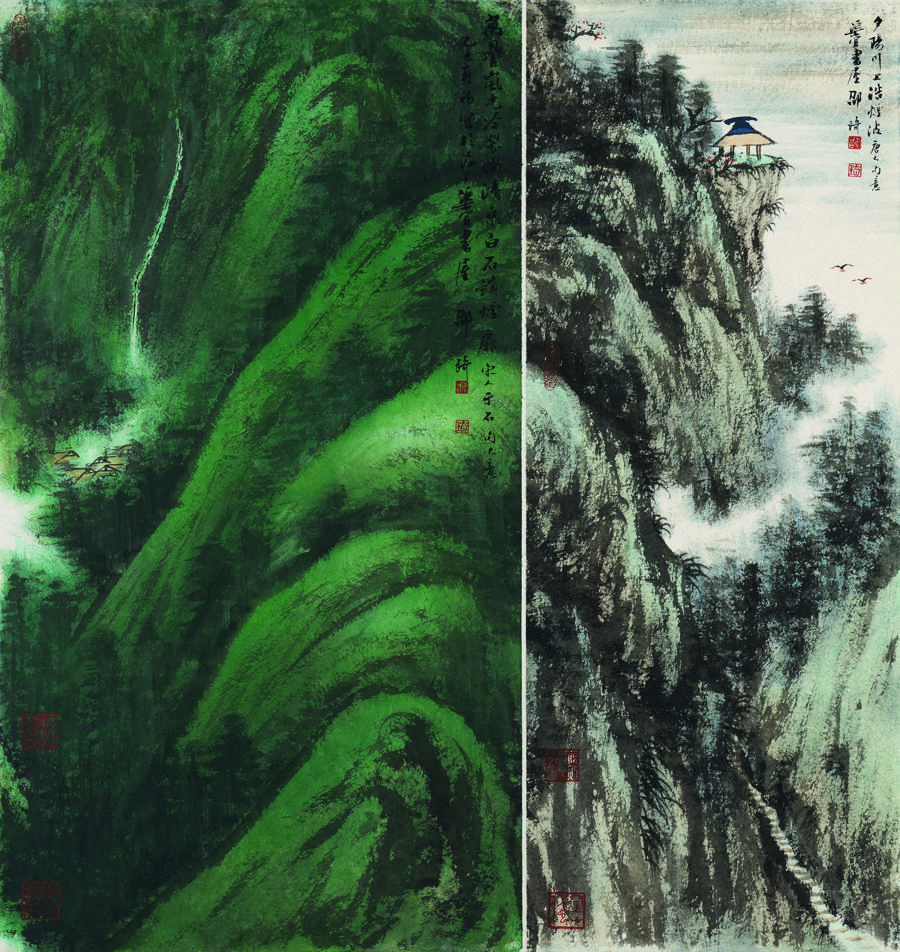
Shao Qi's work "Wan Die Lan Guang Leng Cui Wei"
The phrase 'with pavilions and wings' is taken from the vivid form of the eaves flying over the corners of a pavilion depicted in Ouyang Xiu's' The Drunken Pavilion'. In Shao Qi's writing, this image transcends simple physical representation and becomes a bridge connecting the spirits of literati from ancient to modern times. In the exhibition, whether it is fine brushwork or splashing ink, light ink or green color, all works point to the same pursuit: creating a place where the soul can rest. This creative path that abandons narrative and emphasizes interest is the contemporary continuation of the essence of literati painting since the Song and Yuan dynasties.
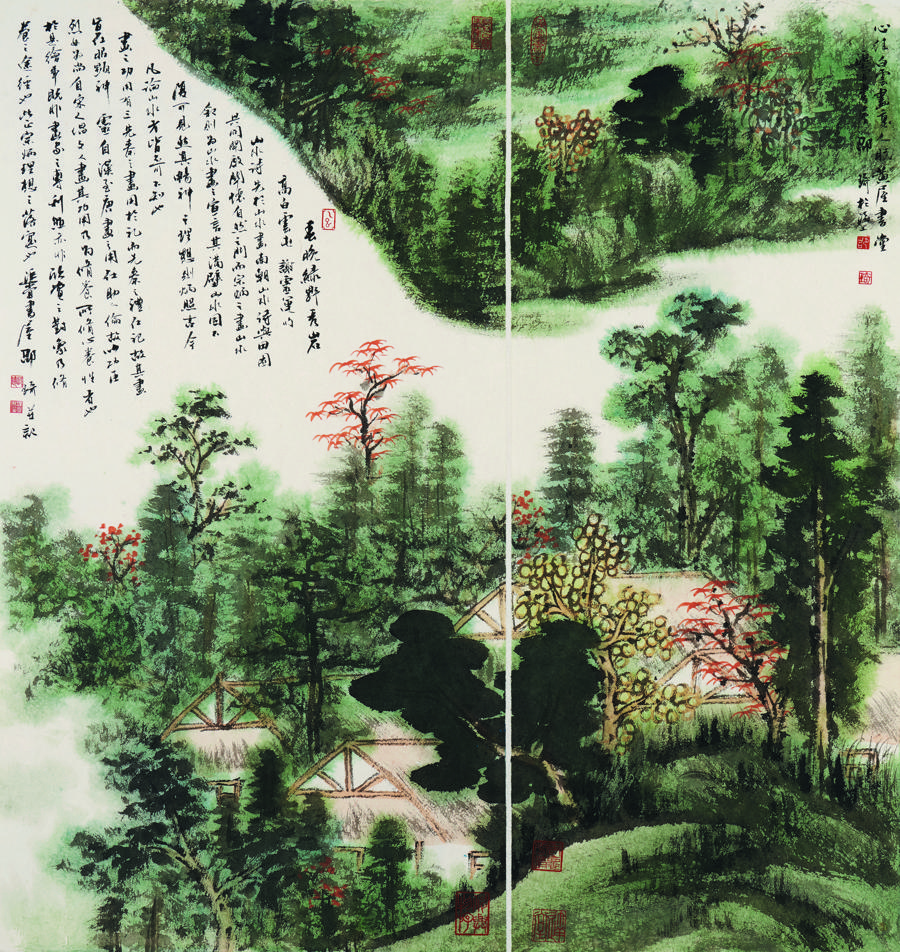
Shao Qi's work "Heart to the Person in the White Cloud Painting"
Standing in front of the painting "Ten Thousand Layers of Blue Light, Cold and Green", viewers can feel the painter's unique understanding of the "pavilion". Pavilions often do not occupy a central position in his paintings, but they can always find the most appropriate way of existence in the mountains and waters - sometimes they are small buildings in the corner of the mountainside, sometimes they are thatched cottages in the woods by the stream, and sometimes they are even hidden in the composition only in the form of imagery. This approach is also the artist's original intention: pavilions are not only physical buildings, but also the moment when people take a break physically and mentally.
In "Half Cliff Hanging", Shao Qi uses the technique of splashing colors to create a misty atmosphere between mountains and waters. The ink blends together, and the outline of the pavilion is faintly visible, just like the portrayal of urban people's longing for nature - it doesn't have to be a real possession, but a moment of spiritual travel.
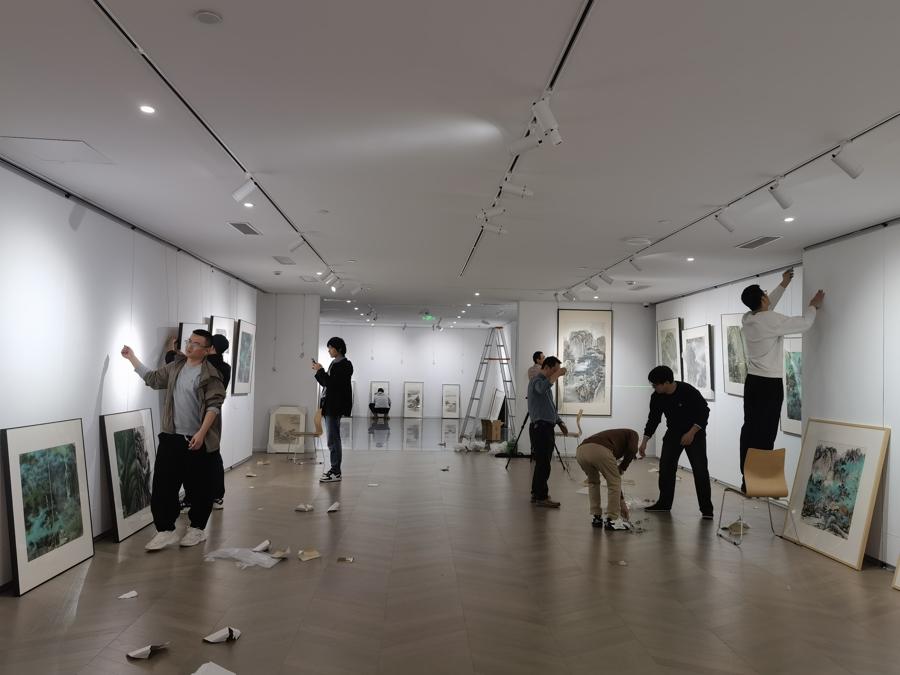
Busy "Shaojiamen" teachers and students at the exhibition site

Shao Qi (left) and Zhang Yuan (right)
The ten-year friendship between curator Yang Baiwei and Shao Qi adds a warm touch of mutual appreciation to the exhibition. Yang Baiwei admitted that this "rock solid" friendship is built on common professional interests, similar editing experiences, and a shared love for food and wine. What is even more rare is that this friendship extends to the field of art education - the teacher-student group jokingly referred to as the "Shaojiamen" by Yang Baiwei, breaking the conventional boundaries of educational systems and forming a continuously growing relationship of artistic inheritance.
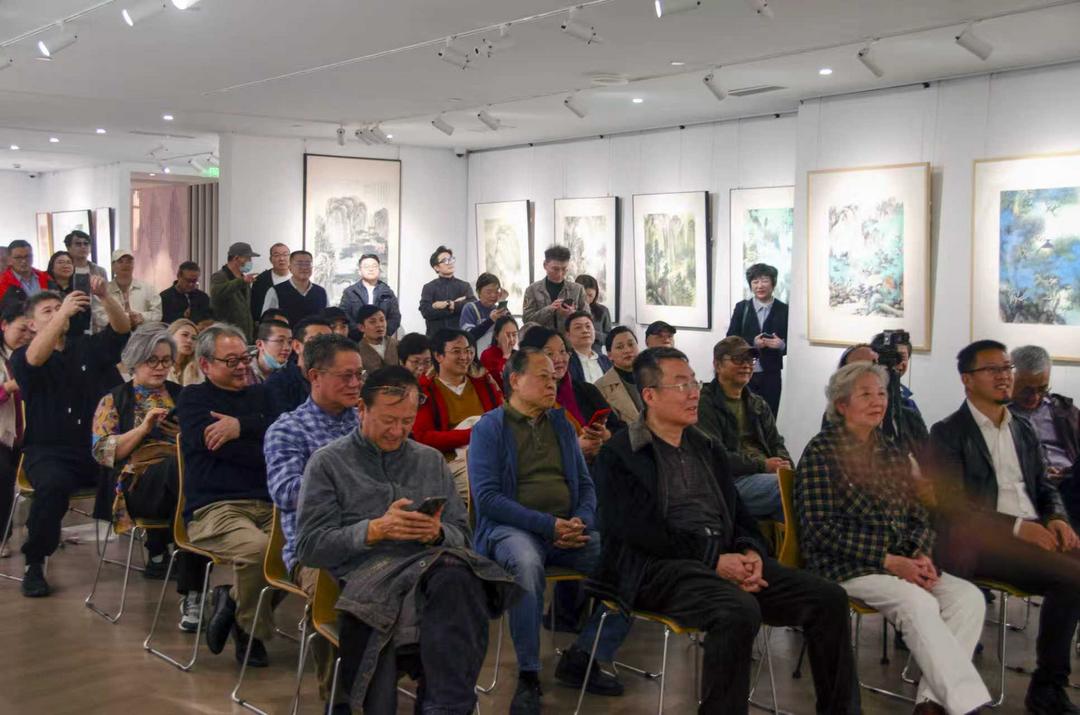
The exhibition by Shao Qi, which deeply cultivates tradition and contemporary consciousness, was held at the Zhang Yuan Art Museum, providing a spiritual habitat for the bustling city to "paint a picture of tranquility". The spatial layout of the art museum is worth pondering. The resonance between the Jufu Caf é on the first floor and the exhibition space on the second floor allows visitors to step into the caf é after enjoying the scenery of mountains and rivers, and savor the beauty of traditional art in typical scenes of modern urban life. This breaks the closed nature of art exhibitions and naturally integrates classical aesthetics into contemporary life.
Shao Qi's works, exhibited at the Zhang Yuan Art Museum, also have another layer of profound meaning. The art museum mainly collects works by Mr. Zhang Yuan and his father Zhang Shoucheng, showcasing the clear lineage of the inheritance of Chinese painting. Shao Qi's exhibition forms a dialogue with this, both paying tribute to tradition and showcasing the continuation of tradition in contemporary art creation.
Source: Shangguan News Author: Xinmin Evening News Xu Yisheng


